

Welcome to my annual report about population health in Sefton. The report for 2025 takes a closer look at the topic of child poverty; what life and health is like for low-income families in Sefton’s communities, and why creating change for the better should be everybody’s business.
Foreword
Welcome to my annual report about population health in Sefton. The report for 2025 takes a closer look at the topic of child poverty; what life and health is like for low-income families in Sefton’s communities, and why creating change for the better should be everybody’s business.
There are lots of good reasons to take a deeper look into this issue now, not least the impact of rising living costs, which remains an everyday source of stress, worry and hardship for many. In 2025, the NHS launched its plans for a more localised, neighbourhood-based model of health and care, and December saw the publication of the first national child poverty strategy for England in nearly a decade. In our region, Champs Public Health Collaborative published a Child Poverty Framework for Cheshire and Merseyside. This adds to the range of place-based activity within the Marmot Communities Programme, targeting the social and wider determinants of health inequalities.
Sefton was one of the first Councils to develop a dedicated child poverty strategy, which is intended to span from 2022 to 2030. As we approach the halfway mark, it is worth taking some time to reflect on progress and share the range of changes being implemented in Sefton to prevent and reduce child poverty. Equally, this public health annual report is an opportunity to spell out the continuing scale and challenge of child poverty alongside the potential difference we can make by growing our collective awareness, listening to children, families and carers, and making thoughtful changes where we can. This report is one of several resources that the Child Poverty Strategy Steering Group will launch in 2026, and I hope you will find it a valuable source of information and inspiration.
This report draws on a variety of evidence to illustrate key issues and reflect the lived experiences of local families. Case studies, images and first‑hand quotes from children and parents demonstrate how the inability to afford basic essentials shapes the everyday lives of thousands of young people in Sefton.
Child poverty is a complex issue with lots of interrelated causes and solutions. We have tried to make this report as informative, meaningful, and accessible as possible, with chapters tackling four questions: What is Child Poverty? What does poverty mean for children’s health and opportunities in life? Who is responsible for stopping child poverty and the inequalities linked to it? What ambitions do we have for the next four years of the strategy?
The report also includes a section looking at what has happened since last year’s report, which looked at a related theme – What Keeps us Well, focusing on the experiences of young adults.
To help us share the information in this document with as many people as possible. A printable, accessiable PDF of the PHAR is here a shorter, simplified version is also available to download and print on our website here.
You can also view or listen to individual chapters online in multiple languages. If you need the report in an alternative format such as large print, please contact us on 0345 140 0845 or email public.health@sefton.gov.uk.
I would like to thank everyone for their enthusiastic involvement in the preparation of this report and on behalf of Councillor Mhairi Doyle, encourage everyone to find out what it has to say.
Rory McGill – Sefton Council Interim Director of Public Health

Welcome to Sefton Council’s 2025 Public Health Annual Report.
This report is an invitation to add your commitment to tackling child poverty in Sefton. It is also a welcome opportunity to review, reflect on, and recognise the important changes that are already happening through our growing collaborative efforts in this area.
Sefton has some of the biggest health inequalities in England for key measures such as life expectancy. Early onset of preventable health problems is influenced throughout life by the circumstances in which we live and the opportunities and support available to us. However, evidence shows that health inequality scene is set during childhood. This is why early life disadvantages in health and other areas of life have been described as casting a ‘long shadow’[1] over young people’s later health and life chances as they grow into adulthood.
The report is based on Sefton’s Child Poverty Strategy, which was developed when Sefton declared a Poverty Emergency in 2021. Since then, living costs have continued to rise and the priorities around improving people’s Pockets, Prospects and Places are perhaps even more relevant today.
I welcome this report’s focus on simple-to-understand, practical actions which we know can make a difference to low-income children, parents and carers. As an issue which cuts across society, it is understandable that the immensity of addressing child poverty can feel overwhelming to many. However, this report provides an accessible way to understand its causes and consequences, where change can make a difference, and what that looks like in real life, using first-hand experience, key statistics, and case studies.
As the Cabinet Member for Health and Wellbeing, I commend this report and hope it will inspire you to support families who are less well-off. I believe there is much more we can all do in Sefton to help prevent child poverty and limit its effects on children’s health and wellbeing, and that doing so brings benefits for everyone. Please get in touch if you have any feedback or suggestions on how we can work together to address the issues raised in the report.
Councillor Mhairi Doyle
Cabinet Member for Health and Wellbeing
|
We would like to extend our sincere thanks to the many individuals, teams and organisations whose dedication, insight and collaboration have shaped this Public Health Annual Report and continue to drive the delivery of Sefton’s Child Poverty Strategy. Our heartfelt thanks go first to the children, parents and carers across Sefton who have generously shared their experiences, perspectives and hopes for the future. Their voices remain at the centre of this work, reminding us why reducing child and family poverty must be a shared priority across the borough. We are grateful to colleagues across Sefton Council, whose commitment spans every department. Tackling poverty requires sustained, coordinated action across systems, and the enthusiasm shown by teams and staff at all levels reflects the Council’s ongoing commitment to fairness, inclusion and opportunity for all. Special thanks go to the partners who drive and support Sefton’s Child Poverty Strategy. This includes the Child Poverty Steering Group, which works to help embed poverty-aware practice across the borough. Our thanks extend to Sefton CVS. Voluntary, Community and Faith organisations across the borough play an essential role in supporting families, offering practical help, emotional support, food and fuel assistance, advice services, and safe, welcoming spaces. Their responsiveness, compassion and understanding of local communities make them indispensable partners in tackling poverty and inequality. We also acknowledge the vital contribution of our colleagues across the NHS, including Sefton place-based partners, primary care networks, Family Hubs, neighbourhood health teams, and wider Cheshire and Merseyside programmes—particularly All Together Fairer and the Champs Public Health Collaborative—whose commitment to addressing the social determinants of health continues to strengthen our collective efforts. Finally, we thank all those who provided data, analysis, lived-experience insights, case studies, and local intelligence to inform this report. Their contributions help ensure our work remains grounded in evidence, responsive to need and focused on making a meaningful difference. Together, your time, expertise and commitment continue to shape a fairer, healthier and more hopeful future for children and families across Sefton. Thank you.
|
Child poverty remains a significant and growing challenge in Sefton. In 2023/24, 22% of children lived in relatively low‑income households, the highest figure in a decade. Poverty affects every community, though some neighbourhoods continue to experience deeper and more persistent disadvantage. Its impacts are extensive: poorer physical and mental health, reduced school readiness and attainment, social exclusion, and long‑term constraints on life chances. Evidence shows that children growing up in poverty face higher levels of Adverse Childhood Experiences, greater health risks, and substantial learning lags that widen as they progress through school.
Sefton’s Child Poverty Strategy (2022–2030) provides a coordinated, system‑wide framework to prevent poverty where possible and reduce its effects where it exists. The strategy focuses on three core pillars:
- Pockets: Strengthening family finances, maximising income, tackling the poverty premium, and reducing hidden and avoidable costs.
- Prospects: Improving early years development, narrowing attainment gaps, supporting school engagement, and expanding opportunities for skills, participation and aspiration.
- Places: Creating healthier, safer, more connected neighbourhoods with improved housing, accessible transport, quality green spaces and inclusive community environments.
Progress over the past year includes the expansion of Poverty Proofing® in schools, increased uptake of Free School Meals and Healthy Start, enhanced income‑maximisation support, and the embedding of poverty‑aware practice across council and partner services. These developments have strengthened shared understanding, improved early identification, and contributed to more coordinated action across the system. However, key challenges persist: widening inequalities between neighbourhoods, rising living costs, complex service navigation, continued housing quality issues, and one of the largest educational attainment gaps in England for children from low‑income families.
Reducing child poverty requires collective, sustained action. As Sefton approaches the midpoint of its 2022–2030 strategy, the focus is on deepening partnership working, strengthening prevention, addressing entrenched inequalities, and embedding child poverty considerations consistently across major local plans and services.
Report Recommendations / Calls to Action
-
Embed a child poverty lens across all services
Systematically assess the impact of policies, decisions and service design on low‑income families; reduce hidden costs and improve accessibility. -
Strengthen early identification and prevention
Improve coordinated, neighbourhood‑based responses to financial stress, housing issues, early learning needs and mental health concerns. -
Improve access to secure, fairly paid employment
Expand pathways into stable work, skills and training for parents and young people; address in‑work poverty and job insecurity. -
Reduce cost pressures and the poverty premium
Increase uptake of Free School Meals, Healthy Start and benefits support; minimise unnecessary or avoidable costs across schools and services. -
Embed child poverty within major local strategies
Ensure the Health & Wellbeing Strategy, the new Local Plan and neighbourhood models explicitly prioritise poverty reduction, prevention and inequalities in long‑term planning.
The following statements reflect the reality for many families in Sefton who are struggling with their finances:
- Children in Sefton are going to school hungry
- Families in Sefton are choosing between heating their homes and putting food on the table
- Many families in Sefton who were previously managing now find themselves unable to do so, and some families are living in deep and persistent poverty, feeling no hope of a way out.
In Sefton, we are focused on tackling child and family poverty.

‘In short, child poverty means parents can’t afford the basics of food, clothing and shelter.’
-The Children’s Society
This first definition of poverty emphasises that poverty is about not having enough money. Families that do not have enough money to buy the basics for their children are in poverty.
‘[Poverty is] when a person’s
resources... are not sufficient to meet their minimum needs (including social participation).’
-The Joseph Rowntree Foundation
The second definition of poverty tells us that poverty is about more than people not having enough money to meet their very basic needs.
For example, a family may be unable to afford to:
- Spend leisure time with family and friends because going out is too expensive
- Pay for their children to take part in activities such as school trips, after-school clubs, or music lessons
- Buy birthday presents for their children or attend social events in their community
The new national Child Poverty Strategy, Our Children, Our Future[1] also makes clear that the effects of poverty are bound up in what it means when families cannot afford the essentials needed to give children a secure and healthy childhood – such as good meals, a warm and safe home, appropriate clothing, and the chance to fully participate in education and everyday life. It also recognises that poverty today increasingly affects working families, where parents are doing the ‘right thing’ but still cannot make ends meet due to low pay, insecure work and rising living costs.
Living in poverty has a significant impact on people’s lives and life chances. For children, it can often mean doing less well at school, experiencing poorer physical and mental health, and having fewer opportunities to grow positive self-esteem and confidence. Poverty often brings constant stress, shame, stigma and anxiety for both children and parents, and its effects can last well into adulthood.
- We recognise significant local potential to improve the social and economic factors associated with poverty; therefore, the extent of child poverty and the inequalities it causes should not be seen as fixed or inevitable. With that said, the widespread causes and impacts of poverty make it clear: tackling child and family poverty cannot fall to one service or organisation alone; it is a responsibility we all share in Sefton.
Measures of child poverty in Sefton
There are three main ways to measure child poverty. Knowing about these helps to reveal more about the patterns and causes of poverty and to focus attention on the main challenges and priorities: increasing family incomes, reducing the cost of essentials, and strengthening local support so children can grow up healthy, safe, and able to reach their potential
- Children living in relatively low-income households
This measure refers to children whose family has claimed one or more of Universal Credit, Tax Credits or Housing Benefit at any point in the past year, with household income before housing costs less than 60% of the middle-ranking (median) income nationally. This measure tells us how many children are affected by a lack of financial resources to meet basic needs and how this compares with other areas.
- Income Deprivation Affecting Children Index (IDACI)
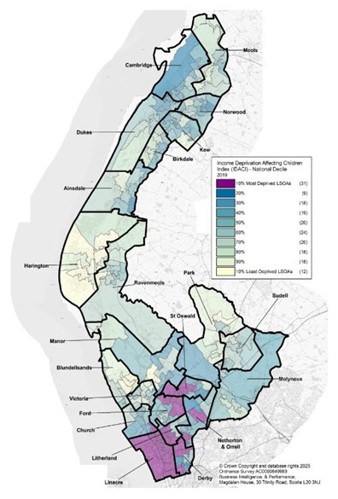
This score combines seven components of deprivation: Income, employment, education, skills and training, health and disability, crime, housing, living environment, plus the percentage of 0-15s living in low-income households. The Index of Multiple Deprivation (IMD) is useful for showing the parts of Sefton where children are more likely to experience wider poverty of experience and opportunity, beyond family income struggles.
- Children Eligible for Free School Meals (FSM)
 Eligibility for FSM is also based on being in receipt of a range of benefits. FSM eligibility is a helpful way to link low-income status to children’s educational achievements and to track changing patterns of childhood inequality over time and across places.
In March 2021, Sefton Council declared a poverty emergency. This was to recognise the scale of child and family poverty in the borough. Since then, the after-effects of the pandemic and rising living costs have meant poverty levels have increased, with the latest
data suggesting that just over one in five under-16s are experiencing child poverty.
In 2023/24, 22% (10,560) of children aged 0–15 in Sefton lived in relatively low-income households, aligning with the national average. This is the highest number recorded in the past decade, marking a 48% overall increase over that time.
The percentage of low-income families varies substantially across the borough, as illustrated in the IDACI map. Areas shaded in purple indicate the highest concentrations of children in low-income families (the highest being 52%), with the lighter yellow areas falling amongst the least deprived 10% in England, i.e., these are neighbourhoods which are particularly well-off.
Child poverty causes and risk factors
There are many complex reasons why child and family poverty exists and persists in Sefton, and not all of them are things we can readily influence at a borough level.
- Some important drivers of child and family poverty are: rising cost of living,
- level of income from benefits, and
- level of income from employment. Some more specific risk factors are listed in the box below.
Some groups are at greater risk of child poverty
Some groups in the population face additional costs or more thinly stretched incomes. Children growing up in these families are more likely to experience poverty during some or even throughout their childhood:
- Children are particularly vulnerable to poverty if they live in a family:
- with multiple siblings
- with a single parent
- where no one is working
- Individuals with a disability, or those with a child with a disability: costs might include spending on specialist equipment, increased utility bills, and additional transport costs.
- Minority ethnic groups and migrants: costs might include visa charges and application fees, the NHS surcharge and difficulty accessing affordable credit.
Multi-generational poverty: children born into a poverty-stricken area are far more likely to experience hardship and disadvantage as adults, as prolonged exposure significantly decreases opportunities in later life.
It can be easy to make assumptions or fall back on stereotypes when an emotive term like "poverty" is used, but the facts and figures below show this is a false step.
Evidence suggests tackling poverty in Sefton requires action on pockets, prospects and places
Pockets
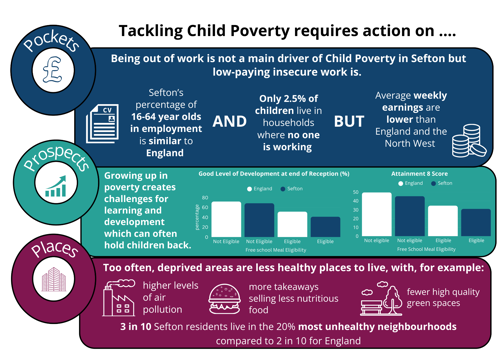
Being out of work is not a main driver of child poverty in Sefton, but low-paying, insecure work is.
74.0% of 16-64-year-olds in Sefton were in employment in 2024/25, a proportion similar to England's, 75.7%.
Sefton has one of the lower rates of 16- and 17-year-olds who are not in education, employment or training (NEET) in 2023/24, 3.7% (vs 5.4% in England).
Only 2.5% of children live in households where no one works (vs 9.5% in England).
Average weekly earnings per person in 2025 were lower than the average, £587.10 (vs England £632.50 vs North West £604.70).
Prospects
Growing up in poverty often creates additional challenges for learning and development. These begin to hold children back from the start of their lives, and the gap keeps widening.
Percentage of children not eligible for free school meals achieving a good level of development at the end of Early Years Foundation Stage (Reception), 2024 = 68.5% (vs England 72.0%).
Percentage of children eligible for free school meals achieving a good level of development at the end of Early Years Foundation Stage (Reception), 2024 = 41.3% (vs England 51.5%). This equates to a six-month learning lag when comparing disadvantaged children in Sefton to non-disadvantaged peers in England as a whole.
Average Attainment 8 score at GCSE of children not eligible for free school meals, 2024 = 45.4 (vs England 49.7)
Average Attainment 8 score at GCSE of children eligible for free school meals, 2024 = 31.0 (vs England 34.7). Compared to non-disadvantaged peers, average educational attainment at this stage in Sefton is on average two years and two months behind.
Places
Too often, areas of high deprivation are less healthy places to live, for example, higher levels of air pollution, more takeaways selling less nutritious food, and fewer high-quality green spaces.
Percentage of the Sefton population living in the 20% most unhealthy environments (Access to Healthy Assets and Hazards Index) 2024 = 31.0% (vs England 21.0%).
Sources:
Wider Determinants of Health | Fingertips | Department of Health and Social Care
Annual Report 2024: Local Authority gaps - Education Policy Institute
Cheshire and Merseyside Integrated Care Board, All together fairer beacon indicators
Sefton does not have significantly higher levels of unemployment of unemployment; young people are more likely to continue in education, employment and training at age 16 and 17; and almost all households with children, which are classified as low-income have at least one adult who works.
Cost of living
Many families in Sefton are struggling to meet the cost of living, leading many to be at risk of falling into poverty. The costs of essential goods have increased significantly in recent years, including household bills, food, council tax, and rent.
It is important to recognise that although there was a focus on the ‘cost of living crisis’ in 2021, these cost pressures have not gone away for families. In fact, for many families, the situation has become worse. This is summarised by a parent in Sefton:
“(I am) always worried about how the cost of things is constantly going up,
and how I’m going to manage to put food on the table, never mind pay bills”
Source: Understanding Child Poverty in Sefton report (October 2023)
In addition to these costs, it is important to recognise that households experiencing poverty will often have to pay and shop around more than better-off households for many goods and services. This is known as the ‘Poverty Premium’.
As explained by charity Fair by Design:
‘Nearly every household on a low income in Britain pays extra for things that are essential to life, like energy and food. This is known as the poverty premium, the extra costs that people on low incomes pay just because they are locked out of better deals or cannot pay.'
Source: Fair by Design, Understanding the Poverty Premium
Examples of the Poverty Premium for families include:
- Borrowing and credit: Families in poverty pay more to borrow money. It can cost someone on a low income around £200 more to use high-cost credit. This higher cost is due to people on low incomes often being seen as ‘riskier’ by lenders, and therefore they may have access only to higher-cost credit, if any at all.
- Upfront costs: Services often offer lower overall rates in exchange for an upfront fee. Many low-income households are unable to afford this and opt to pay monthly instead, resulting in higher overall costs.
- Insecure work: people in this role must pay more for transport and childcare because they receive their shifts on shorter notice.
Income: Benefits and social security
One source of income for individuals and families is the social security system, including benefits such as Universal Credit. Most lower-income families in Sefton receive income from employment and benefits.
However, benefits often do not keep pace with the real-world cost of living for individuals and households.
For example, Universal Credit, the most widely claimed benefit in the UK, is not calculated based on the actual cost of living. This means that the amount people are receiving frequently does not meet the needs of individuals and families.
In addition, the benefits system can be confusing to navigate. Often, people are unsure what they are eligible for or may worry that taking up one benefit could make them ineligible for another. Some people encounter additional difficulties due to literacy challenges, dyslexia, or not having English as a first language. As a result, people are often missing out on essential support.
This issue is summarised in the Understanding Child Poverty in Sefton report (October 2023), which highlights the issues facing local families:
‘All [the] families [spoken to] received benefits to varying extents. Families commented on how the benefits system does not always meet their needs. Receiving welfare benefits means that housing options are limited and current housing (especially for families residing in local authority accommodation), does not always meet families’ housing needs. Families stated that even minor changes to the benefits they receive can lead to financial difficulties. Families spoke about how the benefit system does not always make sense to them.’
Although benefits may not always cover the actual cost of living, it is essential that families receive all available support. Readers of this report can refer to section six, ‘Find out more’, for sources of support and guidance which can help families access the benefits they are entitled to.
Income: Employment
It is important to recognise that employment is not a guaranteed route out of poverty. People’s wages are not keeping up with the cost of living. In addition, insecure work can exacerbate this issue, as families are unsure what will come from month to month. Therefore, many households across Sefton with one or even two adults in work are not earning enough to meet their household’s needs.
‘The families, whether containing employed adults or not, had limited incomes and were suffering financial hardship. Importantly, families containing working parents were equally as likely as workless families to say that they were experiencing financial hardship.'
Source: Understanding Child Poverty in Sefton report (October 2023)
This highlights the significant issue of in-work poverty in Sefton and demonstrates that, to tackle poverty in Sefton, we must support people in accessing well-paid, secure employment.
Having money worries makes everyday decisions into a big deal – do you replace the empty shampoo or the empty cereal? Is it worth walking another half mile to see if the other shop has bread at a lower price? Constant financial juggling takes up a lot of mental effort. It can be hard to even think about long-term plans, especially when costs are involved. Managing the here and now often leaves little time and energy to focus on personal ambitions.
We recognise that many of these pressures are caused by decisions and broader factors outside of people’s control. While it is important to recognise these wider factors, we must focus on what we can do locally as we all have a role to play in addressing child and family poverty.
The key message in this chapter is that child poverty is commonplace in Sefton and present in every community, although levels in some areas are much higher than others. However, data alone cannot fully capture the lived reality of poverty. To understand its true impact, it is equally important to listen to the experiences, stories and voices of the children and families who are directly affected.
The most important things for us to understand are the causes of poverty and the reality of its effects on children and families. In the next chapter, we share further information and stories from families in Sefton that highlight some of the far-reaching impacts of living in poverty. These provide important insights about how we can prevent it and its bad effects.
Key Points:
- Many families in Sefton struggle to afford everyday essentials
- Some neighbourhoods experience much higher levels of hardship and deprivation than others
- Rising living costs, low wages, difficulties with the benefits system, or circumstances like having a disability or being a lone parent can all result in child poverty
- Poverty is a constant source of stress for families
[1] Our Children, Our Future: Tackling Child Poverty - GOV.UK
A day in the life: growing up in poverty in SeftonThe alarm goes off at 6:30am, but the house is already awake. The prepayment meter flashed “LOW CREDIT” last night and topping it up will have to wait until payday and the boiler has been unreliable for months, so the morning air is cold. Nine‑year‑old Liam pulls his jumper over his trackie bottoms before getting out of bed. His mum is already up, standing in the freezing kitchen packing school bags. Breakfast is toast made from the last loaf she bought at the discounted aisle. There’s no cereal today, and the milk ran out yesterday. Liam doesn’t complain. He’s learned not to. On the familiar walk to school, the road is busy with traffic. Liam walks along the wet pavement and notices all the litter tangled up in the brambles at the edge of a grassy area which doesn’t seem to belong to anyone. In some parts of Sefton, life expectancy can differ dramatically between neighbourhoods only a few miles apart, and Liam’s family lives on the side where new opportunities feel thinner on the ground and days can feel longer. His school is warm, and the teaching staff are caring, but it’s too obvious who brings packed lunches and who waits for the free school meal, Liam thinks. Lunchtime is the part of the day when Liam feels most full—and the part when he realises he might not feel that way again until tomorrow. At 1pm, the class begins a topic that will involve doing some researching on the internet. Some children can log into the homework portal with ease at home; Liam silently hopes the teacher won’t assign anything online‑only tonight. The family’s phone data is often used up before the end of the month, and broadband Wi-Fi is a luxury they cannot maintain. He wants to keep up—he’s bright, curious, and asks thoughtful questions—but poverty imposes limits on him that he didn’t choose. After school, Liam heads straight home. His mum apologises—again—that he can’t join the after‑school sports club. The fees, the kit, even the bus fares add up. Instead, she keeps him company at the kitchen table while he colours worksheets under the dim light of a single bulb. They can’t afford to keep spares of things, so it had better not blow. Dinner is spaghetti with tinned tomatoes. His mum eats only a little so he can have more. She’s been skipping meals more often lately, stretching the weekly shop as far as possible. Liam notices, even when she insists she isn’t hungry. As the evening settles, the cold creeps back in. They pile blankets on the sofa and watch free‑to‑air TV until bedtime. Liam curls up beside his mum, sharing the warmth. They talk about the weekend—maybe a visit to the park, if the weather holds. It’s free, and running around outside makes them both feel lighter. Before he sleeps, Liam thinks about the things other children seem to have without thinking: warm houses, full cupboards, working laptops, clubs, holidays. He doesn’t envy them exactly—he simply wonders what it would be like not to worry. Tomorrow will look much the same. But beneath the routine, the weight of poverty shapes every choice: what they eat, where they go, how they learn, and the opportunities they can reach. Liam is full of potential, but potential needs space to grow—space that inequality in Sefton too often narrows for children like him. |
Adverse childhood experiences
Living in poverty is not only a lack of income; it is a chronic stressor that shapes children’s everyday experiences, environments and relationships. Poverty is recognised as an Adverse Childhood Experience (ACE). This term refers to stressful or traumatic experiences during childhood, such as parental separation, domestic abuse, parental mental ill‑health, substance misuse, neglect or living in unsafe or unstable environments. Evidence consistently shows that low family income increases the likelihood of all types of adverse childhood experiences before the age of 18. Not only this, but experiencing multiple ACEs, in turn, increases the probability that individuals will encounter their own challenges with low income in adulthood. From this, it is easy to see how child poverty and unfulfilled potential can span generations and why this is an issue for communities and society as much as for individual families and children.
A day in the life: Mia's storyThe kettle clicks off before it’s light in Bootle. Eleven‑year‑old Mia pulls the duvet tighter around her shoulders, keeping in what little warmth there is. The house isn’t freezing, but the heat never lasts. Downstairs, her mum, Jade, is making packed lunches, spreading the last bit of jam thinly across two slices of bread. She’s been on nights at the care home all week. She looks tired, but she still gives Mia a little smile when she walks into the kitchen. Mia knows her mum is under pressure — the bills, the shift patterns, the strain of managing everything alone. Children notice more than adults think. Mia has seen the letters on the counter and heard the quiet phone calls. The stress sits in the background of daily life. It’s the kind of persistent pressure some adults call an Adverse Childhood Experience, though Mia wouldn’t know the term. Walking to school, the pavements are still wet from the night before. Mia passes the familiar sights — busy roads, small parks, old terraces. She likes school, especially art, but feels a tightness in her stomach when classmates talk about weekends or birthdays she knows her family couldn’t afford. It isn’t embarrassment. It’s an awareness that money shapes what feels possible. Jade understands that feeling. She grew up in Litherland in a home that was always trying but always short. There were money worries, cramped rooms, and the constant worry about whether things would stretch. That was normal for her as a child. She remembers ‘giro day’ clearly. Her mum would be up early, listening for the post arriving, waiting for the brown to envelope come. When it landed, it was a moment of relief. The envelope would be opened straight away, and her mum would go out quickly to top up the gas and leccy before the meter cut out. By the afternoon, most of the money had already gone on rent, bills, food, and the other things that couldn’t wait. Giro day wasn’t a good day; it was a brief pause before everything started again. As she got older, Jade realised how much of life in Bootle depended on knowing how to navigate systems that didn’t seem to be designed around families like theirs. It wasn’t about savings or security, it was learning how to get by, how to manage, and how to cope with shortages. Scraping by wasn’t a choice; it was what had to be done. That early instability stayed with Jade. She feels the effects in how she manages money, how she worries, and how she always prepares for something to go wrong. Poverty leaves marks that continue into adulthood unless the right support is there. The issue came close to home again recently. Mia’s cousin, Callum, who is just a year older, has gone to live with a foster family in Crosby. Mia misses him. They used to spend a lot of time together. Now she only sees him some weekends. Jade explained that it wasn’t Callum’s fault or his mum’s. Things had been difficult for a long time — overcrowding, financial pressure, other problems starting to build up too. Professionals recognise that children living with long‑term hardship are at much higher risk of entering care. For Mia, it simply feels like her cousin is no longer there. At school, she works quietly. The classroom is busy, and pupils talk as they complete worksheets. Some mention doing more work at home, but that isn’t always possible for Mia. Their flat is small, and evenings are noisy. There isn’t a quiet space to concentrate. She copies from the board carefully, hoping her effort goes unnoticed. Her teacher checks in with her, aware of the pressures many local families face — but Mia prefers to stay in the background. By late afternoon she’s home, sitting at the table while her mum prepares tea. Her younger brother plays on the floor. The house feels warmer when everyone is in. Over tea, they talk about the future. Mia says she would like to be a nurse one day, maybe at Alder Hey. Jade is proud of that. She tells Mia that her path doesn’t have to be shaped by the past or by the difficulties around them. Later, they sit together on the sofa before bed. When Mia lies down for the night, she thinks about the day, the parts that felt heavy and the parts that felt alright. She doesn’t yet understand how larger forces shape her life: rising costs, lack of opportunity, stress passed from one generation to the next. She doesn’t realise that without the right support at the right time, children in situations like hers and Callum’s can end up reliving the same struggles that their parents faced. But in homes like Mia’s across Sefton, there is stability where it can be found, resilience where it’s needed, and potential that deserves space to grow. |
Mental health
Living in poverty has a significant negative impact on people’s mental health and emotional wellbeing. This is not surprising, considering the draining effect of the constant difficult decisions that families need to make, such as between heating your home, eating well. or replacing some items of school uniform.
Also, many families live in fear of unexpected expenses, such as a broken washing machine, especially if they have no savings to fall back on. Consider the stress, worry, and anxiety this causes for both parents and children.
The following quotations were taken from the Understanding Child Poverty in Sefton report (October 2023), which highlights these issues:
‘Children being aware of parents worrying about whether they can afford the next meal or heating costs increases anxiety’
[Sefton support agency worker]
“We know of families who are really struggling, and people have come to us in tears, very stressed and lost, not knowing what to do for the best…”
[Sefton support agency worker]
“Money does not necessarily make people happier, but not having to stress about not having enough money for what you need is so important. Not having money enough leads to stress and ill health for both parents and children”
[Sefton child]
Physical health
There is a clear link between poor health and poverty, both in childhood and later life. For example, children living in poverty are less likely to have good nutrition or live in healthy homes. This helps to explain Sefton’s higher than national average rates of:
- A&E attendances in under 5s
- 5-year-olds with tooth decay
- Child obesity.
- And recent research has also found higher rates of stunted growth in poorer communities in Sefton.
Source: A Rapid Situational Analysis on Child and Family Poverty in Cheshire and Merseyside
There are many complex reasons for this, including:
- Limited access to healthy and affordable food due to increased cost of healthier food options
- Cost barriers to attending hospital appointments (for example, transport costs)
- Living in poverty means you are more likely to be living in housing that contributes to ill health, for example, damp problems, or being unable to heat your home properly.
Source: Kings Fund (kingsfund.org.uk/insight-and-analysis/long-reads/relationship-poverty-nhs-services)
Social exclusion
Families are also having to miss out on social opportunities and activities due to cost. As well as feeling unfair, this also means some children in Sefton experience social exclusion and isolation. This creates numerous knock-on effects on children, such as shame, embarrassment, lack of confidence, and even guilt if they know their parents are going without so that they can pay for their children to attend activities or events.
‘Financial hardship meant that few families were able to save for unexpected expenses or ‘non-essentials’ such as holidays. Hobbies tended to be limited to those requiring minimal financial outlay such as watching television or reading. Financial hardship meant that most adults had very limited social lives…some parents were concerned that there are too few outdoor spaces nearby for children and young people.’
‘Another child spoke about how children from poorer families miss out on events taking place in schools and/or their community. Most suggested that school events and activities should be free for all. She talked about how families with more money can afford to go on holiday and enjoy leisure activities. This meant that families with more money could go places and do more, while poorer families are limited to places such socialising at home or at family or friends’ houses.’
‘Some children believed that the parents of children attending school trips were … going without so that their children could go.’
Having new experiences and gradually growing our understanding of the wider world is an important part of learning and social development. Being comfortable about having a stake in the world beyond places we know well equips children with softer inter-personal skills that give them confidence to get along with new people and speak up for themselves in unfamiliar situations. Research1 suggests that differences in this skillset go some way to explain the gap in adult incomes between young adults who grew up in disadvantaged and non-disadvantaged households even when they left school with the same grades.
Education and social mobility
Communities with low social mobility are those in which the influence of parental socio-economic status exerts the strongest influence on the educational and economic outcomes of children.[1] Bootle - one of the most deprived and disadvantaged parts of Sefton, has lower social mobility than 98% of England.[2]
On average, children from lower-income households are less likely to do well at school. This impacts children’s futures and their life chances. There is no single, simple explanation for this difference between low-income households and households that are better off. Rather, there are several possible related factors that cause these outcomes.
For example:
- Hungry children are unable to learn as effectively
- Poorer mental health is associated with poverty and has a negative impact on learning
- The effects of poverty and the cost of the school day are sometimes factors in lower attendance at school, which impacts overall learning
- The learning environment at home can make studying hard, for example if home is cold, noisy, crowded, lacks private spaces, basic furniture and amenities like a desk, computer of wi-fi
- Children may have additional caring responsibilities which reduce the time and energy they have for learning
- Parents or carers may themselves have had difficult experiences of education and school, which can be a disadvantage when it comes to supporting their children’s learning
The reality of this is reflected in Sefton, for example pupils from families living on the lowest incomes in Sefton, measured by eligibility for Free School Meals, experience some of the largest ‘learning lags’ in England.
By the end of Reception, Sefton pupils lag the national average amongst non-disadvantaged peers by 5.9 months. At Key Stage 2, the gap is 11.3 months, and at Key Stage 4 Sefton has the fifth largest gap in England, with a difference of over two years (25.9 months).
Sources: Nygaard A, Armitage H, Boyce T (2025) Pockets, Prospects, Places: Sefton’s Child Poverty Strategy. London: Institute of Health Equity and the Education policy institute (2024) Annual Report 2024: Local Authority gaps - Education Policy Institute
Below is an illustration of the ‘building blocks’ of good health and wellbeing. It is easy to see how poverty and deprivation could weaken each of these blocks and the foundations of a healthy life.
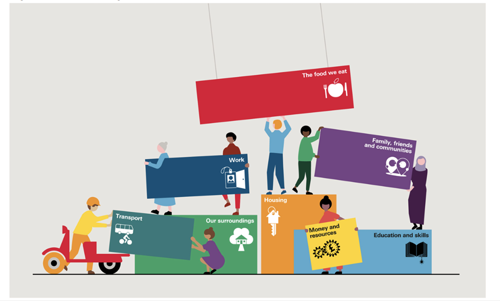
Source: The Health Foundation, What builds good health
These are just some of the ways poverty affects children and families in Sefton. These issues are interconnected. For example, consider how social isolation and poor mental health can impact on a child's education.
It is critical to address child and family poverty because it has the potential to create such deep and enduring impacts on quality of life and life chances.
Key Point:
1. Poverty can harm health and wellbeing, education and learning, and long-term prospects
It is true that many of the drivers of poverty sit beyond local control and the scale and complexity of the challenges it poses can feel overwhelming. Yet we cannot ignore the evidence from Sefton shows that poverty has profound and wide‑ranging impacts on children’s health, wellbeing, education and life chances. Tackling child poverty is a complex and long‑term challenge. It is shaped by multiple, inter-related factors besides income including the cost of living, housing market, education, employment and training opportunities, health, and the wider economic and policy environment. Families’ experiences of poverty are not the same everywhere or for everyone, and the depth and persistence of poverty in some communities means there are no quick or single solutions. Recognising this complexity is the key to creating an effective local response and underlines why tackling child poverty requires sustained, coordinated action across organisations, services and communities, with a focus on both prevention and mitigation, now and for future generations.
Responding to child poverty requires a truly collective approach. In Sefton, this shared responsibility and call to action is set out through the Child Poverty Strategy, which provides a common roadmap for preventing poverty where possible and reducing its impacts where it already exists.
The strategy is a plan focusing on practical, coordinated steps that organisations, services and community, voluntary and faith sector partners across the borough can take to make a difference in children’s lives now, while also reducing their risk of poverty when they grow up.
So, returning to the question at the start of this chapter, ‘who is responsible for stopping child poverty and the inequalities linked to it?’ The answer is that tackling child poverty with any hope of delivering meaningful, lasting change must be a shared endeavour. The Child Poverty Strategy sees this responsibility as being distributed across the Council, public services, community organisations, employers and wider partners, with everyone playing a role to ensure more children and families in Sefton can prosper and thrive.
At its core, the strategy has three overarching goals:
- Reduce poverty levels and time spent in poverty now.
- Minimise poverty’s impact on educational achievement, health, and wellbeing – now and later in life.
- Prevent future poverty for today’s children.
These goals reflect the need to balance mitigation, by supporting families who are currently struggling, with prevention, by improving life chances and tackling the conditions that allow poverty to persist across generations. To achieve this, the strategy brings together actions targeted at income, opportunity and environment, or – Pockets, Prospects, Places.
Pockets, Prospects and Places
These are the priority areas of work taking place in Sefton to tackle child and family poverty.
POCKETS: Maximising financial resources of families on low incomes
The 'Pockets' priorities aim to maximise income and improve financial stability for low-income families.
- Pockets priority 1: Increase the number of households to access employment that provides an acceptable standard of living.
- Pockets priority 2: Reduce the cost of living and remove financial and other barriers that lowers the benefit low- income families get from local opportunities and support on offer.
PROSPECTS: Improving the life chances of children in poverty
The ‘Prospects’ priorities aim to provide opportunities to families and children that support long-term development.
- Prospects priority 3: Act early and focus on the needs of parents to create the best possible support for children’s learning and development at home
- Prospects priority 4: Narrow the educational attainment gap between children from low-income families and their better-off peers.
PLACES: Creating connected, inclusive, distinctive environments where everyone can enjoy the good things in life
The ‘Places’ priorities aim to ensure that environments are shaped to support children and families to thrive.
- Places priority 5: Ensure the places where we live and spend time are strong on the fundamental, universal things everyone needs to live well.
- Places priority 6: Create more connected, accessible and inclusive spaces, that support social cohesion, diversity and participation.
The table below has some examples of some of what the actions under each priority are concerned with and illustrates the breadth of involvement that is required.
The table below has some examples of some of what the actions under each priority are concerned with and illustrates the breadth of involvement that is required.
Pockets |
Prospects |
Places |
|
Managing cost of living |
Accessible support and services |
Transport and connecting places |
|
Income maximisation |
Education, learning, skills |
Housing |
|
Tackling hidden costs |
Working with parents (including colleagues) |
Community safety, community cohesion and pride in place. |
|
Free or low-cost activities |
Employment and training opportunities |
Healthy streets and neighbourhoods, public parks and greenspaces. Access to nature. |
|
Help with essentials, e.g. food |
Sport, leisure, arts and culture and fun |
Inclusive economic growth |
Making change happen: your top 10 poverty‑smart actions
We all are all responsible for tackling child poverty, and the good news is that meaningful change is achievable through the everyday decisions we make, the way we think about, design and deliver services, and how we work with children, families and communities.
Some actions may feel small but taken together they add up. The more people and organisations that act consistently and collaboratively, the bigger and better the change. By working together to prevent poverty where possible and reduce its harmful impacts where it already exists, we can improve outcomes not only for disadvantaged children and families, but for the whole population. You do not need to have a specialist role or work directly with families to make a difference. Actions that may feel small in isolation, such as reducing barriers, challenging assumptions or making services easier to access, can have a significant impact when they become part of ‘how we do things’.
The following tips highlight practical ways in which anyone, regardless of role, can help reduce the pressures of poverty and create a better experiences, which do not only benefit low-income children and families. Taken together, they show how shared responsibility and collective action can lead to bigger, more lasting changes.
- Keep child poverty in mind in everyday decisions
Think about how costs, access and assumptions might affect children and families on low incomes. Asking simple questions like “Will this make things harder or easier for low‑income families?” helps bring a child poverty lens into everyday work.
- Make services easy to access and affordable
Reduce or remove hidden costs where possible, such as travel, equipment, food or childcare. Provide clear information upfront about any costs to help families plan and avoid last‑minute barriers or embarrassment.
- Use clear, respectful and inclusive communication
Avoid jargon and use simple, accessible language. Provide information through different channels, recognising that digital access, literacy and confidence vary. Frame support as something for everyone, not just those “in need”.
- Challenge stigma and assumptions
Poverty can affect working families, lone parents, disabled people and many others. Avoid assumptions about family circumstances, budgets or priorities. Treat all families with respect, dignity and empathy.
- Listen to lived experience
Where possible, involve children, parents and carers in shaping, reviewing or improving services. Their insights help identify barriers that data alone may miss and support more effective solutions.
- Know what support is available and signpost confidently
Take time to understand local support, benefits advice, food and fuel support, community groups and voluntary services. Being able to signpost promptly and confidently can help families access help earlier.
- Be flexible and understanding
Financial insecurity often makes life unpredictable. Offering flexibility around timing, attendance or requirements can remove significant stress and help families stay engaged.
- Think long‑term as well as short‑term
Support that helps families cope today is vital, but so is action that improves life chances over time. Anything you can do to bring young people, parents and carers closer to positive experiences in education, skills, and employment opportunities is valuable and the same goes for working with communities to create healthier places to live and grow up.
- Work together
Child poverty cuts across housing, health, education, transport and employment. Strong relationships and collaboration with colleagues and partners help ensure families are not passed from service to service without support.
10. Remember: everyone has a role to play
Whether you work with families directly, manage staff, design services or shape policy, your decisions matter. The more people and organisations act together, the bigger and more lasting the impact.
In short: make it easy, affordable, and welcoming for all.
Embedding a child poverty lens into everyday work
Everyone has a role to play in reducing child poverty, and when lots of us decide to do something differently it can make a big difference. However, lasting, meaningful change only happens when these actions become part of everyday practice, not one‑off efforts.
By embedding a child poverty lens into the tools, processes and routines that guide our work, we can create fairer and more accessible services for families experiencing financial pressure.

To support the shift from individual effort to shared, embedded practice, it can be helpful to consider the following points:
- Recognise that routine shapes practice The way we work is influenced by habits, routines and the tools we use—such as plans, policies, pathways, templates, forms and checklists. Reviewing these through a child poverty lens can reveal opportunities to build in simple, practical changes that improve experiences for families facing financial challenges.
- Use data systematically
Many organisations already collect valuable information through monitoring, feedback and local insight. Using this data consistently ensures responses to child poverty are informed and proactive. Ask:- Is poverty-related information being gathered but not acted upon?
- Could the data collected—or how it is analysed—be improved to highlight inequalities, unmet needs or under‑represented groups?
- Embed change into everyday tools
For changes to stick, they need to be written into the documents and processes that guide day‑to‑day work. Embedding prompts, requirements or check‑ins helps turn one‑off improvements into routine behaviour and ensures that consideration of child poverty becomes standard practice.
- Make commitments visible and practical
If your team or organisation commits to reducing barriers for families experiencing financial hardship, make these commitments visible in everyday practice. This might include reviewing the affordability of activities, reducing hidden costs, widening access to opportunities, or ensuring information is shared clearly and inclusively. Clear prompts help keep actions consistent across staff and over time.
- Nominate a Poverty Champion
A named Champion can help maintain focus, share learning, and encourage colleagues to apply anti‑poverty approaches consistently. This helps ensure that progress is sustained and not just dependent on individual enthusiasm.
Best practice inspiration from Sefton partners
Select and insert vignettes from draft training resource Partner examples tackling child poverty in Sefton.docx
Key point
- You can help tackle child poverty by recognising the signs, challenging stigma and helping families access support
What we’ve done well: progress, partnership and recognition
Over the past year, Sefton has continued to benefit from a strong set of implementation success factors that underpin our progress. These include a clear governance structure, a shared evidence base, and agreed tools and processes that help partners act consistently and confidently. These foundations, first identified through the development of the Child Poverty Strategy, continue to play a crucial enabling role in delivering change across the borough
Pockets: maximising family resources and removing hidden costs
A major achievement has been the continued expansion of Poverty Proofing® the School Day, which has grown from a small delivery‑partner model into a large, place‑based programme. Nearly 1,200 people across school communities have engaged in this work so far, helping to identify and remove financial and social barriers so that no child is excluded because of their circumstances.
Our income maximisation work has also delivered measurable impact. Using the Low‑Income Family Tracker (LIFT), Sefton has proactively identified families who meet eligibility criteria for Free School Meals and helped simplify access, including through auto‑enrolment. This has ensured that 164 children now receive a guaranteed hot meal every day, saving families around £495 per year and bringing over £220,000 in recurring pupil premium funding into schools. In addition, the value of Free School Meals for families equates to around £450 per child per year, meaning this work is generating an estimated £73,800 of direct annual financial benefit for Sefton families.
To strengthen financial resilience further, Sefton produced a bespoke Healthy Start awareness film, featuring local places and familiar voices, making the national scheme easier for families to understand and apply for. The film is designed to raise awareness of what families are entitled to and to signpost them to the people and services who can support them with the application process.
Prospects: supporting children’s learning and narrowing gaps
To embed consistent poverty‑aware practice across services, Sefton has developed a new Child Poverty e‑learning module for all Council colleagues. This will help every service – whether frontline, commissioning, community‑based or corporate – understand how financial pressures shape families’ lives and how simple, everyday changes can make services more accessible.
In parallel, 25 schools across Sefton have now completed Poverty Awareness and Poverty Proofing training, building a growing network committed to inclusive practice. This includes 7 secondary schools, 15 primaries, 2 special schools and 1 PRU.
Schools and partners are also reviewing uniform policies; enrichment offers and participation costs – reducing the hidden expenses that prevent children from fully taking part in school life. LIFT insights support this, helping identify needs earlier and shape local responses that reduce inequality in access to opportunities.
Alignment with national and regional strategy
The Institute of Health Equity (IHE) has highlighted Sefton’s Child Poverty Strategy as an example of local leadership and an evidence‑led approach aligned with All Together Fairer, the major regional programme addressing the social determinants of health across Cheshire and Merseyside.
This recognition is increasingly viewed as a strategic strength for Sefton. National bodies have noted both the coherence of our approach and the way in which local partners have mobilised around shared priorities. This positions Sefton as a leading area in demonstrating how evidence‑driven, whole‑system action on child poverty can be embedded in everyday practice.
At the same time, stakeholder awareness of child poverty has grown markedly, supported by regular Show & Tell contributions that highlight practical action, lived experience and emerging insight from partners. This shared learning environment is helping to build a stronger collective understanding of local need and a more coordinated approach to tackling inequality.
Our work continues to be strongly aligned with the direction of national and regional strategy, including the national Our Children, Our Future Child Poverty Strategy—which sets out the government’s decade‑long mission to tackle the drivers of child poverty across the UK—and the All Together Fairer approach across Cheshire and Merseyside. This alignment ensures that Sefton’s local progress complements wider system priorities and maximises the reach and relevance of local action.
In summer 2025, Sefton also hosted the national Child Poverty Taskforce Unit, who visited the borough to meet partners from across Cheshire and Merseyside and hear directly from families about the day‑to‑day reality of financial hardship. Their visit reflected growing national interest in practical, people‑centred approaches and the value of listening to lived experience to shape policy and practice.
The establishment of the Child Poverty Strategy Steering Group has strengthened partnerships and accelerated system‑wide action, working alongside schools, public services, health partners and the VCSE sector. This collaboration continues to be highlighted as emerging best practice both locally and nationally.
Across Sefton, we are seeing a shift not only in outcomes but in culture:
- Poverty Proofing principles are becoming embedded in routine practice.
- Staff and partners are adopting a shared language and perspective with greater confidence.
- Data‑informed targeting is helping families access support earlier and with dignity.
These achievements reflect a growing collective responsibility across the borough and align strongly with the renewed national focus on tackling child poverty through long‑term, whole‑system action. Together, these successes demonstrate what is possible when local insight, strong partnerships and a commitment to reducing inequality come together with purpose and ambition.
Where we need to do better? Challenges, gaps and priorities
While Sefton has made strong progress through partnership working, data-led approaches and a growing network of poverty-aware practice, significant challenges remain. These areas will require deeper focus, sustained leadership and continued collaboration if we are to reduce poverty levels and narrow inequalities for children and families.
Address persistent and widening inequalities between neighbourhoods
Poverty is not evenly distributed across Sefton. Some communities experience far higher and more entrenched hardship, requiring long‑term, place‑based investment and coordinated partnership action.
Strengthen early identification and prevention
We need more systematic and proactive identification of financial stress, housing issues, and knock-on effects on children’s learning and wellbeing.
Reduce ongoing cost of living pressures for families
Rising living costs continue to outpace income for many households. Improving access to affordable essentials and tackling the poverty premium remain priorities.
Improve access to secure, well‑paid employment
Sefton’s labour market continues to be affected by low pay, insecure contracts and seasonal work. Stronger pathways into stable employment and skills development for parents and young people are essential for long‑term resilience.
Engagement with and support to large private employers and small medium enterprises (SMEs)
Local employers, both major anchor businesses and SMEs play a vital role in tackling in‑work poverty. We need stronger collaboration to:
- promote good‑quality work, fair hours and progression
- reduce barriers for parents and carers returning to work
- support workplaces to adopt poverty‑aware practices
- increase opportunities for apprenticeships, work experience and early careers support for young people.
More to do as anchor institutions
Anchor organisations across Sefton—including the council, NHS partners, schools, colleges and large employers—hold significant influence over local economic, social and environmental conditions. There is more to do to:
- use procurement and commissioning levers to support low‑income families
- improve access to good work and training
- reduce carbon, transport and cost burdens on families
- model poverty‑aware practice consistently across all decision‑making.
Continuing obstacles to sourcing information and navigating networks of support
Families and frontline staff frequently report that systems remain too complex, inconsistent or difficult to navigate. We need clearer pathways, reduced duplication, and more trusted, joined‑up community‑based routes into advice, health, financial support and early help. Improving digital access, simplifying language, and increasing coordination between services are key priorities.
Narrow the educational attainment gap
Children eligible for Free School Meals in Sefton experience some of the largest learning gaps in England. Targeted work is needed to improve attendance, tackle digital exclusion, strengthen early years development, and support families to build positive home‑learning environments.
Strengthen consistent poverty‑aware practice across all services
While progress has been strong in many areas, we need further embedding of poverty‑aware practice into commissioning, workforce development, procurement, service design and governance.
Improve access to safe, warm, good‑quality housing
Families continue to report poor conditions including damp, mould, overcrowding and difficulty heating homes. Housing quality remains a critical determinant of health and a major source of stress for parents.
Strengthen inclusion, reduce stigma and amplify lived experience
Families, including children experiencing poverty too often feel judged, excluded or unheard. Authentic co‑production must be strengthened so that support is shaped by lived experience rather than assumptions.
What’s changing around us?
Across Sefton and beyond, the landscape of partnerships and approaches to tackling child poverty is rapidly evolving, with organisations increasingly working together in new, more integrated ways to respond to the complex challenges facing local families. Work such as the Sefton Families First Partnership (FFP), Family Hubs and NHS Neighbourhoods continues to develop and will be better able to help joint work on tackling child poverty. By organising support around neighbourhoods, the aim is to improve people’s ability to access services. This is an essential step in a borough where families report difficulty obtaining help early enough. Evidence from local research shows that financial hardship for parents and children has many causes. Housing pressures, rising living costs and limited access to support all play a part. This highlights the value of a more integrated community‑based approach. This model also aligns closely with wider regional ambitions to reduce inequalities. The All Together Fairer programme across Cheshire and Merseyside emphasises acting on the social determinants of health through strengthened partnerships, targeted place‑based interventions and a prevention‑first mindset.
A neighbourhood approach also makes it easier to tailor interventions to Sefton’s diverse communities. Coastal towns with seasonal employment patterns or areas influenced by the Port of Liverpool face distinct challenges. Embedding services within our neighbourhoods means support can be shaped around real‑world local conditions such as employment, housing, transport access and access to health services. This sensitivity to local concerns is crucial for tackling entrenched inequalities that affect children’s long‑term prospects.
Additionally, the substantial insight work carried out into lived experiences of poverty across Sefton’s communities has reinforced just how vital local voices are in shaping what effective support looks like. This body features the voices of residents from Bootle to Southport. Sefton’s Family First model strengthens the borough’s long‑standing commitment to neighbourhood‑led working by embedding services in familiar community settings, such as Family Wellbeing Centres. This place‑based way of working and helps build the trust between residents and services that is so important in Sefton’s diverse communities by giving families real influence over how they are set up and run.
Looking ahead to 2030
As Sefton approaches the halfway point of its 2022–2030 Child Poverty Strategy, our focus is shifting firmly towards our future ambitions. The next five years represent a critical window to accelerate progress, deepen collaboration and embed the systemic changes needed to ensure that fewer children grow up in poverty and that those who do are better protected from its long-term consequences.
Sefton is building on strong foundations: evidence‑based local action; long‑standing community partnerships; an asset‑based approach that listens and responds to lived experience; and a whole‑system commitment across the Council, schools, health, CVS partners and employers.
Child poverty now has growing visibility and traction across major local strategies:
Major local plans such as the forthcoming Health & Wellbeing Board Strategy (HWBS), due for publication in June 2026, the emerging Neighbourhood Health Care Model, and importantly, the new Local Plan for Sefton, which is due to begin development shortly, all present significant opportunities to embed child poverty, prevention and inequality reduction at the heart of long‑term planning.
The publication of Our Children, Our Future – the new national Child Poverty Strategy (2025) provides a renewed framework for long‑term poverty reduction, placing greater emphasis on early intervention, social security reform, place‑based working and whole‑system collaboration.
The introduction of a National Child Poverty Monitoring Framework and the inclusion of child poverty within the draft Local Government Outcomes Framework (LGOF) will bring clearer, more consistent data. This will help improve local intelligence, targeting and performance monitoring, making Sefton’s work more measurable, relevant and evidence‑driven.
These developments support Sefton’s commitment to making child poverty visible at every level of policy and decision‑making, ensuring that the voice of children and families is recognised in long‑term planning across the borough.
By 2030, Sefton aims to create a borough where the circumstances of a child’s birth have a much weaker influence on their life chances. This means significantly reducing the wide inequalities that currently exist between neighbourhoods—particularly those areas that have experienced persistent disadvantage, low social mobility and limited economic opportunities.
Pockets: Increasing financial security and reducing cost pressures
In the coming years, we will work together to strengthen families’ financial resilience by improving access to secure, fairly paid work, expanding skills and training opportunities, and reducing the hidden costs that make everyday life more expensive for low‑income households. Sefton@Work will remain central to this effort, supporting residents into training and good‑quality jobs as part of the borough’s wider economic and anti‑poverty work. National policy developments such as the Get Britain Working White Paper reinforce this focus by boosting support for people currently excluded from the labour market. Locally, a coordinated, poverty‑aware approach—reducing the poverty premium, removing unnecessary costs, and ensuring families can access the financial help they are entitled to—will help more households increase their income, reduce financial strain and build long‑term security.
Prospects: Ensuring all children can learn, participate and thrive
The next phase of work will intensify efforts to close the educational attainment gap, benefit the learning environment at home, and increase participation in enriching experiences that shape learning and self-esteem. This includes the work of Sefton Early Years, supporting strong early development and school readiness; the borough‑wide Ready to Learn agenda, promoting a shared approach that prepares children, families and schools for successful transitions into education; and Early Help, which identifies emerging needs early and coordinates support around families before issues escalate.
Poverty awareness also remains central ensuring that no child’s future prospects are limited by household income, stigma or financial barriers. As part of our ambition to broaden horizons, Sefton continues to create opportunities for children and young people to develop skills, confidence and aspirations through creative and cultural programmes, taster days linked to regeneration initiatives, and partnerships that connect young people with emerging sectors and local employers. Regeneration‑linked activities, supported through Sefton’s wider economic and skills programmes, offer valuable exposure to employment pathways and skill‑building experiences for young people across the borough.
Together, these initiatives help ensure that every child in Sefton can participate, learn, aspire and thrive—regardless of family income or background
Places: Creating healthier, more connected environments
By 2030, Sefton intends to have transformed many of the social and physical environments that shape childhood—improving housing, transport routes, public spaces and neighbourhoods – better designed with children in mind. This includes major place‑shaping initiatives such as the Strand Transformation Programme in Bootle, the restoration of Southport Pier, the development of the Marine Lake Events Centre and associated public‑realm improvements through Les Transformations de Southport, and significant new housing delivery through Sefton’s partnerships. The borough’s ambitions are also supported by the Liverpool City Region Local Transport Plan 4 (LTP4), which sets out a future‑facing, integrated and accessible transport system across the region, including Sefton.
Achieving these ambitions requires continued whole-system leadership, meaningful involvement of residents and sustained collaboration between the Council, NHS, schools, employers and community partners.
By 2030, Sefton’s ambition is clear: fewer children growing up in hardship, more children achieving their potential, more families able to live well, and stronger, healthier and more connected communities.
1. Embed a Child Poverty lens across all services
All council, health, education and partner services should routinely assess how policies, decisions and practices impact low‑income children and families. Embedding poverty‑aware tools, prompts and training will help reduce hidden costs, remove access barriers, and ensure more families receive support earlier.
2. Strengthen early identification and prevention
Services should work together to spot financial stress, poor housing conditions, early learning challenges and mental health at the earliest opportunity. Earlier intervention—through Family First, neighbourhood health teams, schools and Family Hubs—will prevent escalation into crisis and improve long‑term outcomes.
3. Improve access to secure, fairly paid work
Sefton should continue expanding pathways into stable employment, skills and training, with Sefton@Work playing a central role. Supporting parents and young people to access good‑quality jobs, alongside tackling in‑work poverty, is essential for financial resilience and long‑term security.
4. Reduce the cost of living and hidden costs for families
Partners should continue work to remove the poverty premium, reduce school‑day costs, improve access to financial help, and expand income‑maximisation support. Ensuring families can access Free School Meals, Healthy Start payments, benefits advice and affordable local services will help alleviate day‑to‑day pressure.
5. Enhance the position of child poverty within major local strategies
Child poverty is gaining increased visibility within Sefton’s strategic plans. As the Health and Wellbeing Strategy moves toward publication, there is a clear opportunity to ensure that child poverty, prevention and inequality reduction remain central to its final priorities. Likewise, the forthcoming development of the new Sefton Local Plan provides an important mechanism for embedding child poverty considerations into long‑term planning for housing, transport, economic development and place‑making. Ensuring child poverty is consistently and explicitly reflected across these major strategies, including the Neighbourhood Health Care Model and wider system plans, will help align future investment and service design with the needs of children and families most affected by hardship.
As is customary in the Public Health Annual Report, we provide a lookback of progress since the last PHAR. Our 2025 PHAR explored how we can keep ourselves well and prevent low levels of wellbeing. The scope was those aged 18-25 due to the pressures these young people have felt throughout the pandemic, as well as impacting regional and national issues that have affected our borough in recent years.
Key Recommendations from the PHAR
-
Amplify young people’s voices through creative, participatory methods that allow lived experience to meaningfully shape services.
-
Strengthen access to green and blue spaces, physical activity, social connection, and creative opportunities.
-
Support positive transitions (education, employment, independence) through early help and accessible advice.
-
Promote balanced wellbeing messaging, including the normalisation of low mood and stress, and guidance on managing emotions safely.
-
Address digital harms by promoting safe online behaviours, strengthening safeguarding, and helping young people navigate risk online.
-
Recognise and target the vulnerabilities of the 18–25 cohort, acknowledging that many have experienced disrupted education, financial strain, and reduced opportunities post‑pandemic.
Themes Emerging from Partner Feedback
1. Creative Engagement & Youth Voice
Organisations such as Sefton CVS, Swan Women’s Centre and Southport Education Group reported using photography, art, avatars, creative media and lived‑experience‑based storytelling to engage young people more meaningfully and to shape future provision.
2. Improving Access to Wellbeing Activities
Partners highlighted work to expand physical activity, use green and blue spaces, and develop tranquil outdoor spaces (e.g., Southport College’s “Happiness Project”).
3. Normalising Wellbeing & Building Emotional Literacy
Education providers strengthened staff training to reinforce the PHAR message that low mood and stress are normal, helping reduce unnecessary referrals and promote more proportionate support.
4. Strengthening Connected, Collaborative Working
Living Well Sefton and council services emphasised the value of cross‑sector collaboration and the need to better reach underserved 18–25s, including targeted communications and revised outreach approaches.
5. Trauma‑Informed and Neuro‑affirming Practice
Several organisations, including Swan Women’s Centre and Sefton Council youth services, began embedding trauma‑informed practice, recognising the vulnerabilities highlighted in the PHAR.
6. Responding to Digital Harms
Across partners, there was proactive monitoring of online platforms, strengthened safeguarding, online safety education, and internal reviews of digital risk (e.g., SEG’s DfE 360 audit; Green Sefton’s monitoring procedures).
Future Priorities Identified by Partners
- Improving access to activities and spaces that support wellbeing.
- Developing trauma‑informed, inclusive service cultures.
- Capturing authentic youth voice, beyond survey data.
- Reducing digital harms through education, monitoring and digital literacy.
- Ensuring provision meets the needs of 18–25s by reviewing engagement, marketing and service design.